

Learn more about carbon credits
Carbon Credits
Purchase high-integrity carbon credits that drive meaningful climate impact.
What are carbon credits?
A carbon credit, or carbon offset, is created when one metric ton (MT) of a greenhouse gas (GHG) is avoided, reduced, or removed. To be used as a legitimate carbon mitigation tool, carbon credits must adhere to specific criteria, including:
- Demonstrated additionality
- Baseline-based emissions quantification
- Long-term permanence
To learn more about carbon credits, see our FAQs.
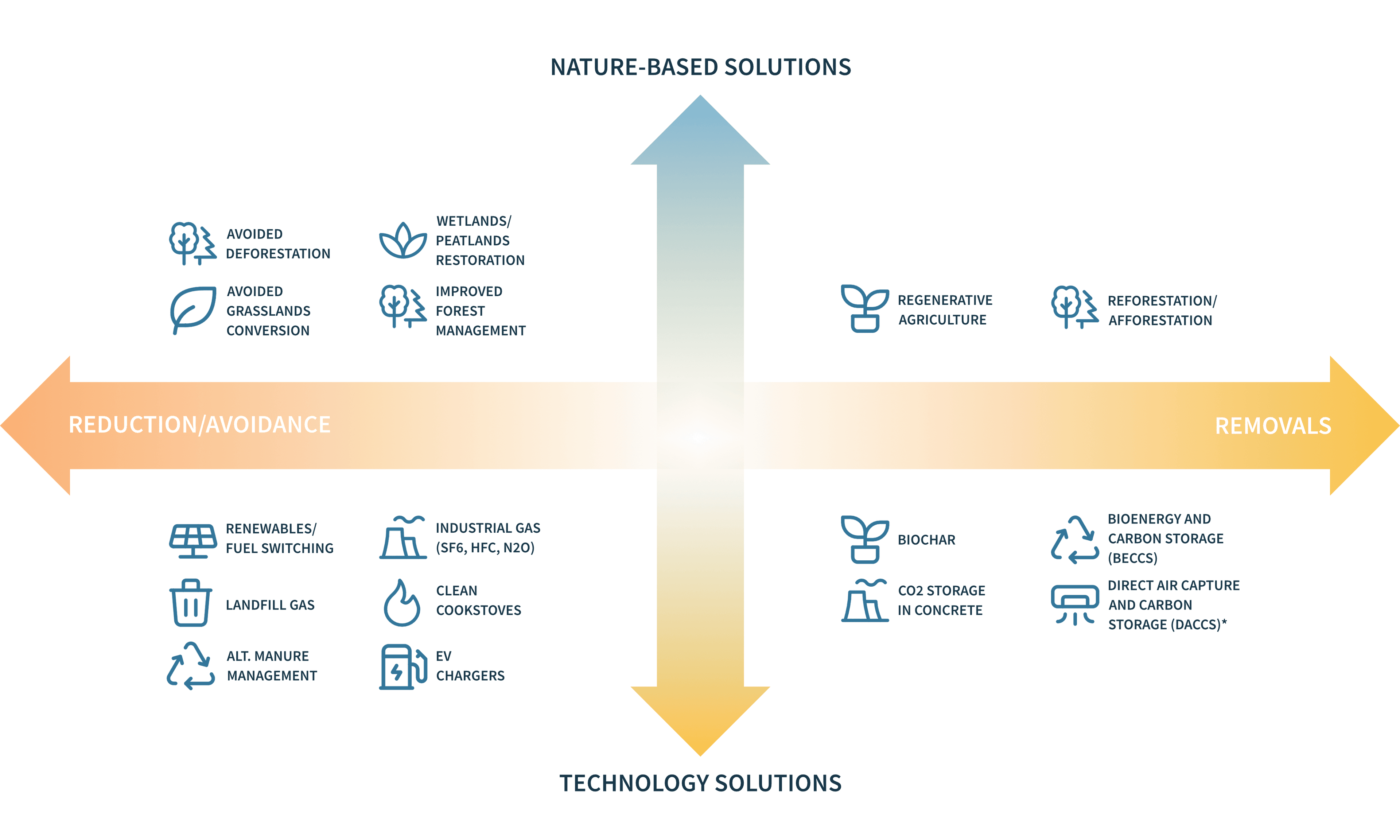
Carbon credit categories and project types
Carbon removal projects
Nature-based solutions
Technology solutions
Benefits of purchasing carbon credits
Carbon credits can play a useful role when they complement a credible emissions reduction strategy and support high-quality climate projects.
Used alongside a robust emissions reduction plan, carbon credits can help compensate for hard-to-abate scope 1 and scope 3 emissions.
Carbon project financing provides essential funding for reductions that would not otherwise occur.
Carbon credit projects can deliver co-benefits such as improved air quality, job creation, and protection of vital environmental habitats.
Frequently asked
Carbon Credit FAQs
Quick answers on credit quality, project types, and how offsets fit into a credible climate strategy.
Carbon credit basics
A carbon credit is created when one metric ton (MT) of a greenhouse gas (GHG) is avoided, reduced, or removed. Carbon credits are also known as carbon offsets or verified emissions reductions (VERs). In order to be used as a legitimate carbon mitigation tool, carbon credits must adhere to specific criteria as detailed below.
Purchasing carbon credits can support the development of carbon projects, as well as the ongoing monitoring, reporting, and verification needed to maintain them over time. Carbon revenue creates incentives for high-emitting, unregulated sectors to pursue reduction or removal activities that go beyond business-as-usual practices.
Quality and integrity
At a minimum, high-quality carbon credit projects will be audited by an accredited, third-party verifier and meet specific criteria dictated by internationally recognized standards bodies. These criteria include additionality, detailed quantification of the greenhouse gas reduction or removal activity as compared to a baseline, and permanence. There are many different types of carbon projects that are eligible to generate carbon credits as long as they adhere to the requirements of methodologies that have been approved by the standards bodies. Furthermore, voluntary carbon projects can be found in many countries across the globe.
GHG accounting is the quantification of GHG emissions produced by an activity or within a boundary. In carbon credit projects, that accounting must follow a precise, conservative methodology that has been scientifically reviewed and tested. It starts with the project’s baseline, or business-as-usual scenario, and then compares that baseline with the actual emissions reduced or removed over a defined reporting period. The difference between the two becomes the number of carbon credits generated.
Carbon credit projects must be additional, meaning the activity would not have happened without the carbon market. Buyers should not be financing reductions or removals that would have happened anyway.
Projects must show that the emissions reductions or removals are not business as usual and must quantify a baseline for emissions before the project was implemented. Additionality can be assessed in several ways, including financial, regulatory, and common practice tests. Each internationally recognized standards body has its own approach.
Permanence means a carbon credit represents a metric ton of greenhouse gas emissions reduced or removed in a way that cannot be reversed. It is also referred to as durability.
Land-use projects often face the greatest permanence risk because stored greenhouse gases can be released back into the atmosphere through intentional or unintentional reversal events. To manage that risk, many projects set aside a portion of credits in a buffer pool so reversals can be covered by canceling an equivalent quantity of credits. Each internationally recognized standards body uses its own methods to assess permanence and reversal risk.
Every carbon project is required to undergo periodic verifications, including an independent ex-post audit that reviews the GHG emissions avoided or removed after the activity has taken place.
Verification helps confirm that the project was monitored appropriately during each reporting period, that enough data was collected to support a robust calculation, and that the project remained in compliance with relevant regulations.
Projects and verification
The main internationally recognized standards bodies are the American Carbon Registry (ACR), Climate Action Reserve (CAR), Gold Standard (GS), and Verra. Each maintains a standard that provides guidelines for new and existing carbon projects and approves methodologies for specific project types.
These organizations also act as registries, or tracking systems, allowing project owners to share documents, issue and transfer credits, and retire them on behalf of end users. Registries help maintain market credibility by documenting issuances and retirements transparently.
Common project types include renewable energy, reducing emissions from deforestation and degradation (REDD), improved forest management, reforestation or afforestation, improved cookstoves, and methane capture or avoidance at landfills and dairy farms.
Carbon projects can be nature-based or technology-based, and they generally address emissions in one of two ways: by avoiding the release of greenhouse gases or by removing carbon from the atmosphere. Avoided emissions projects stop emissions from being released, while carbon removal projects pull or sequester carbon from the atmosphere.
Otherwise known as natural climate solutions, nature-based solutions refer to the conservation, restoration, and/or improved land management practices that increase carbon storage, or avoid greenhouse gas emissions in forests, grasslands, wetlands, or oceans. In addition to the GHG benefits, protecting, restoring, and sustainably managing natural ecosystems helps us adapt to the impact of climate change and provides significant environmental and social co-benefits.
The process from project development to credit issuance can take two years or more because it requires complex accounting and detailed verification to protect environmental integrity.
Project registration and validation happen after a project is developed or implemented. The project developer creates design documents, the verifier audits them, and the standards body reviews and approves the project credentials.
After the project has been implemented and monitored for a period of time, the developer quantifies the greenhouse gases avoided or reduced compared with the baseline, and the verifier audits those findings. The registry then reviews the documentation and, once approved, issues credits. Projects continue through periodic verification and may issue credits annually or in multi-year batches.
Pricing, strategy, and co-benefits
Purchasing carbon credits is not a climate strategy on its own. It should complement near- and long-term science-based emissions reduction targets. Carbon credits can help address scope 1 and 3 emissions that cannot be mitigated in the near term, but they are one tool within a broader decarbonization strategy, not a substitute for direct operational change.
Carbon credit prices vary for many reasons, including project size, location, project type, and ongoing monitoring or verification costs. Projects with strong co-benefits can also command a premium, especially when those benefits align with Sustainable Development Goals (SDGs).
Because carbon credits are a market-based mechanism, pricing is also shaped by supply and demand. Prices typically rise when demand increases or supply tightens.
Co-benefits are the positive environmental and social impacts that come from a carbon project beyond the GHG reduction or removal itself.
Examples include improved air quality near landfill gas projects, habitat protection through improved forest management, or added jobs and income for local communities.

Ready to make an impact?
Explore our catalog of high-quality renewable energy and carbon projects or speak with one of our expert advisors.