Structural shifts and new opportunities for action under SBTi Corporate Net-Zero Standard V2.0
SBTi V2.0 enforces stricter corporate climate rules. Discover the critical decisions your team should make before February 1, 2027.
Learn more about SBTi CNZS V2.0

After more than two years of stakeholder engagement and two rounds of public drafts, SBTi officially published the final Corporate Net-Zero Standard Version 2.0 (CNZS V2.0) on June 11, 2026. Version 2.0 is more workable, more grounded in actions available to companies, and clearer about how to demonstrate real progress.
While the new standard becomes available on February 1, 2027, a structured transition period gives companies with existing or pipeline targets a timeline to continue using V1.3 while also incorporating new elements of V2.0. Ultimately, CNZS V2.0 raises the bar for corporate climate action while providing highly flexible, actionable pathways to achieve real-world emissions mitigation.
SBTi V2.0 introduces considerable improvements to how companies both define and implement their climate goals. First, companies set independent targets for each scope, now splitting scope 1 out by itself. The standard incentivizes action against these targets by introducing a hierarchy of implementation options, prioritizing direct mitigation while also recognizing a sophisticated range of market-based instruments across scopes 1, 2, and 3. By accounting for geographical and sector-specific realities, the framework allows organizations to pursue progress on a realistic, “best-efforts” basis.
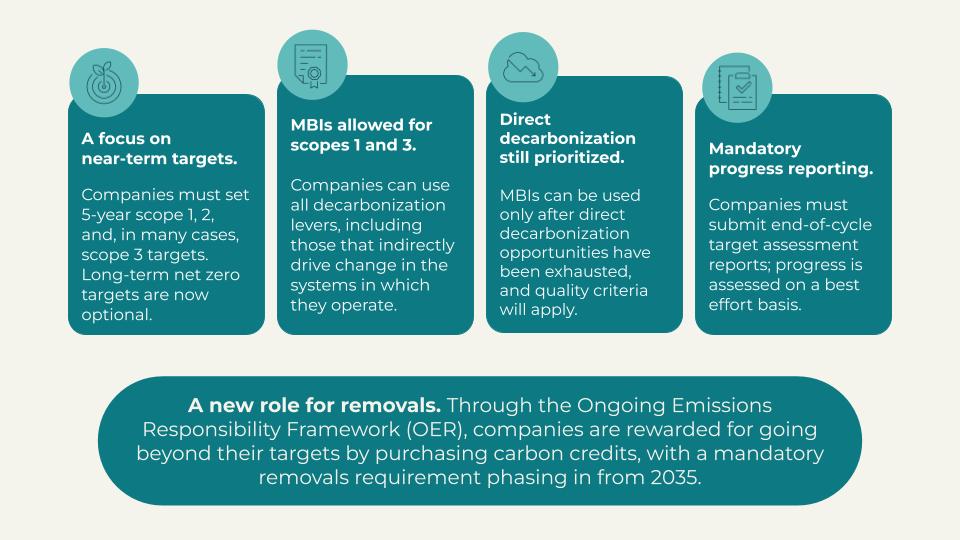
For unabated emissions, the rollout of the voluntary Ongoing Emissions Responsibility (OER) program creates a formalized framework where high-integrity carbon credits and removals successfully complement your internal reduction targets.
The transition window is nuanced. To help your organization prepare, 3Degrees put together a comprehensive breakdown of the core updates in CNZS V2.0 and how to sequence decarbonization investments over the coming months.
The Big Shifts in SBTi V2.0

V2.0 reorganizes target-setting into continuous five-year target cycles, with annual progress reporting and an end-of-cycle assessment backed by third-party assurance for larger companies. Long-term net-zero commitments are recommended, but not required in many cases. This structure creates real accountability with annual reporting and end-of-cycle assurance, rather than a set-it-and-forget-it target.
Organizations can no longer aggregate scope 1 and scope 2 targets into a combined metric. Under V2.0, companies are required to set a standalone scope 1 target using absolute contraction, sector-specific intensity pathways, or a milestone-driven asset transition plan – a useful addition for asset-heavy companies planning transition of specific physical infrastructure over time. Alongside this focus comes new tools: market-based instruments conveying low-carbon attributes (like biomethane and RNG certificates) are explicitly permitted at the activity-pool level, provided they meet strict sustainability criteria.
Market instruments (PPAs, VPPAs, and RECs/EACs) will need to be matched to geographically defined deliverability regions, meaning national or global portfolios may no longer satisfy regional constraints. Furthermore, large electricity consumers (≥10 GWh annually in any region) are now required to track and report the percentage of their power that is hourly-matched with low-carbon electricity within significant regions. Companies may pursue hourly procurement for optional recognition by SBTi.
While the matching rules are getting tighter, SBTi is allowing for new generation technologies to count towards targets. Moving from ‘renewable’ to ‘low-carbon’ electricity for alignment targets allows for electricity generated using nuclear and natural gas with carbon capture and storage.
V2.0 reshapes scope 3 target-setting, first by recognizing that all scope 3 emissions are not created equal. Companies may now focus on only their significant categories (representing greater than 5% of total scope 3 categories 1-14) and may optionally exclude categories over which they lack practical influence, like employee commuting. To address these significant emissions, companies can now choose from overarching emissions reductions, supplier/customer alignment targets, or category-specific volume models. Crucially, the framework formally accepts both project-based accounting and market-based attribution frameworks, unlocking massive potential for companies to pursue supply chain interventions and actions.
V2.0 introduces a formal hierarchy for target implementation: starting with direct emissions reductions within your footprint, then activity pool and sector-level interventions. This gives companies explicit confirmation that market-based interventions will count toward target progress, subject to safeguards and integrity criteria. Companies with existing V1.3.1 targets can begin applying this hierarchy now, including using high-integrity market instruments, without resubmitting their targets.
While the new standard tightens electricity compliance, it introduces an advantageous legacy clause for proactive corporate buyers.
SBTi will recognize long-term market instruments (including PPAs, VPPAs, and long-term REC agreements) executed before the February 1, 2027 effective date for the entire duration of their remaining term under V1.3 rules.
This creates a narrow, high-stakes window for corporate sustainability and finance teams. Evaluating and executing pipeline contracts over the next six months allows your organization to lock in current market flexibility, insulate your business from narrower geographic boundaries, and shield your capital allocation from near-term grid matching volatility.
Implement new solutions for scope 3
SBTi has officially condoned direct procurement, or the use of electricity EACs to address scope 3 electricity, even when the region of electricity consumption is unknown. This simple tool in particular may be valuable for companies seeking to bridge remaining gaps in their current scope 3 targets.
Being able to act in activity pools and at sector level unlocks numerous opportunities for companies to reach scope 3 targets. For example, a food processing company that has already reduced emissions in its own manufacturing sites could invest in methane reduction projects in their sourcing regions and take action at the sector level by investing in low-carbon fertilizer.
How 3Degrees Can Help
As standards evolve and climate policies shift from disclosure to enforcement, 3Degrees converts regulatory complexity into strategic business guidance. Whether you need to conduct a cross-scope readiness review to prepare for V2, audit pipeline energy assets against the 2027 legacy cutoff, source verified biomethane attributes for scope 1 targets, or coordinate complex scope 3 supplier interventions, 3Degrees bridges the gap between market uncertainty and commercial strategy.
What to dive into the technical details with our experts? Sign up for our upcoming webinar below.
On Demand Webinar
“Unpacking SBTi CNZS V2: Updates and Opportunities for Action”
This webinar breaks down of the V2 adjustments and overview of priority corporate actions for the next 6-12 months.