Watch our webinar on the GHGP revisions
Learn more about the proposed changes and potential impacts to your renewable energy strategy.

Stakeholder conversations surrounding the Greenhouse Gas Protocol’s proposed revisions to its corporate greenhouse gas accounting standards are starting to get a bit… exciting.
Having followed the revision process closely over the past few years, we are not surprised by the outpouring of stakeholder sentiments regarding the materials now out for comment. There is a lot to talk about.
Unfortunately while everyone wants a standard that better meets the moment, discussions lean toward “right way/wrong way” debates. Should we be reducing emissions or readying the grid of the future? Should we double-down on an accounting system featuring rough and difficult-to-assemble estimates for value chain emissions, or should we abandon that idea altogether in favor of product ledgers or something else?
Furthermore, we aren’t talking about talking: we expect companies to share their climate progress with stakeholders, clearly and consistently. Yet the claims – the actual messaging that companies use to do this today – are at issue and won’t be helped by new calculations alone.
As such, we would like to contribute a bit of creative problem-solving. We have an idea for a fundamentally new way to think about aiming, accounting for, and talking about how companies impact the electricity sector. We’re calling it the Market-Based Action Statement.
The problem we’re solving
Diving in: the GHGP’s fundamental accounting principles are accuracy, transparency, completeness, consistency, and relevance. We frame the problem-to-solve as:
Properly prepared and disclosed scope 2 emission statements no longer meet the relevance principle. That is, they do not “appropriately reflect the GHG emissions of the company” nor do they “serve the decision-making needs of users, both internal and external” when viewed with today’s lens.
This framing is important because it clarifies that a better scope 2 emissions statement must reflect emissions appropriately and serve decision-making needs of users. These requirements are eminently practical and do not demand that we seek absolute truth in our emissions disclosures. Rather, the goal is that disclosures are appropriately reflective of the company’s (true/actual) emissions. Further, the principle does not require that the emission statement serves all purposes for all users. Instead, its intention is that users’ decision-making needs be served.
We believe this framing provides ample space for problem-solving.

As noted in our most recent post on this topic, scope 2 emission statements that better reflect the physical realities of the electricity grid would enhance the integrity and credibility of corporate emissions inventories. We believe that enhancements to the location-based emission statements will accomplish this goal. In other words, an updated location-based scope 2 calculation method will create emission statements that are appropriately reflective of a company’s emissions.
We have thoughts about the best way to improve these calculations. However, we are setting those aside and are moving to the more challenging need: a market-based disclosure that, alongside the location-based statement, will serve users’ decision-making needs.

To be clear, we remain fully committed to dual reporting – location-based and market-based scope 2 statements.
Market-based inventories enable companies to use their purchasing power to impact the electricity system and its emissions in ways that their physically delivered power cannot accomplish. This is an impact spigot we want to crank wide open, not shut off. At the same time we do not want companies representing their activities in ways that mislead stakeholders or fail to provide sufficient information for decision making.
3Degrees’ proposed solution
- To create a decision-useful market-based electricity impact statement, we introduce a simple, graphical reporting standard. It provides both quantitative and qualitative evidence of the effectiveness and extent of company procurement actions within the electricity system.
- The new statement continues to require companies to provide transparent disclosures of their electricity procurement choices. Though simple and easily digested, the new statement reveals more information than the current standard as it harmonizes many claims companies make disparately today.
- However, the new scope 2 market-based disclosure does not translate the disclosed electricity system actions into a CO2 number. Rather, all actions are framed in megawatt-hours. (See the note at the end of this article1.)
The new disclosure also features a visual, easy-to-grasp action statement driven by a simple, standardized spreadsheet. It comprises four action-wheels (donut charts), each representing a view of actions taken and not taken across a company’s electricity use.
Each wheel’s denominator is the reporting company’s entire electricity use in MWh for the represented boundary – whole company, specific geography, etc. All actions are represented across a range of impact/ambition, with the least impactful/ambitious approach first (starting at the top of the chart), and more impactful approaches represented clockwise around the wheel.
Definitions and distinctions would need to be included in the Scope 2 Standard. In addition, each wheel drives specific, unique electricity action claims that would be specified within the Standard.
Here’s an example of what one company’s action statement might look like.
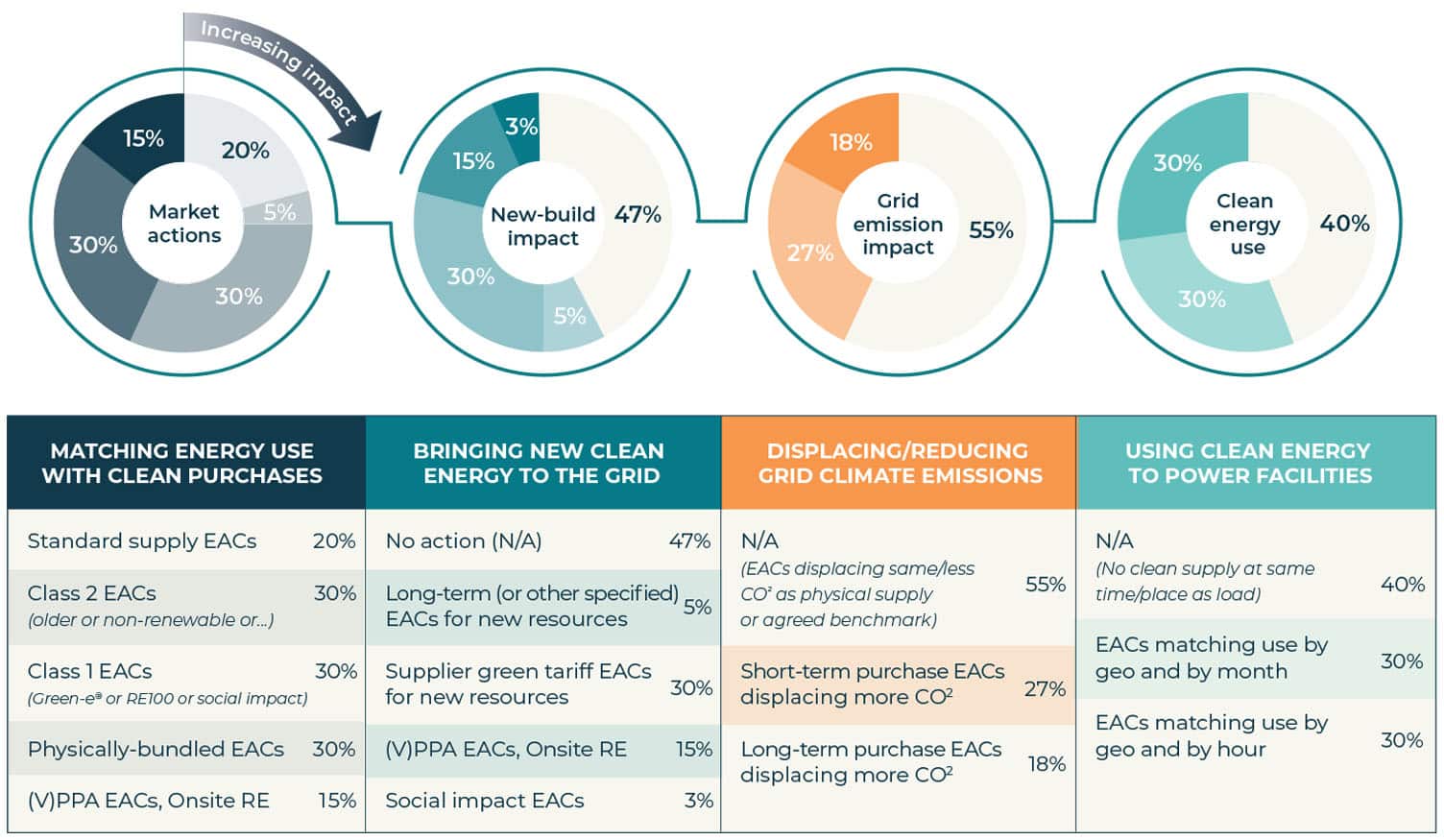
An appropriate, decision-useful disclosure statement
We believe that 3Degrees’ proposed disclosure solution is a better means of accounting for and communicating the impacts of company electricity use, as well as the actions companies are taking to address those impacts.
Benefits of the market-based action statements when taken alongside improved location-based emission quantifications include:
- Its visual, at-a-glance approach;
- The clarity and insight it provides in the actions taken and not taken across several dimensions. By design, the disclosure provides visibility to different kinds of actions, making differentiated and more transparent claims possible;
- It offers multiple parallel action-paths upon which companies and third-party stakeholders can establish and track progress against ambitious goals that are appropriately tailored to company impacts and means;
- The simplicity of its MWh measurements. This enables companies to convert existing scope 2 market-based goals into the new standard’s units in a straightforward exercise that does not require (but can accommodate) changes in the goals’ requirements or levels of ambition;
- Its multiple dimensions offer opportunities to scale/differentiate the new Scope 2 Standard ‘s requirements across different types of reporting organizations; and
- It provides words in support of the pictures. It enables companies to speak about their impacts and progress in clear, agreed terms that do not overstate their achievements.
We look forward to engaging further on these ideas in the coming weeks and months.
1Companies could translate their actions into a CO2 number. We look forward to conversations about the translation between actions and emissions as part of the Actions and Market Instruments standard – noting that a CO2 number could be brought back into the market-based scope 2 disclosure if desired. 3Degrees’ perspective is that we don’t think it’s needed.
More on the GHGP’s Scope 2 revisions

Explore the proposed changes to the Greenhouse Gas Protocol's Scope 2 Guidance and potential impacts to your renewable energy strategy.