
It’s been more than three years since the Science Based Targets initiative (SBTi) released its first Corporate Net-Zero Standard (CNZS) and became a vanguard for voluntary corporate target setting. Since then, the standard has become the most widely used framework for companies setting net zero targets, with over 12,000 companies aligning their climate strategies to SBTi’s guidance.
To support the growing number of companies setting climate targets, SBTi recently launched the SBTi Certification program, enabling experienced sustainability practitioners and consultants to showcase their advanced expertise in science-based target setting. The registry of certified experts serves as a resource for companies seeking guidance on understanding, developing, and submitting science-based targets in line with SBTi requirements.
I earned my SBTi certification in December 2025 and was one of the first North American professionals to do so. This certification validates the advanced knowledge and experience gained through years helping companies measure their greenhouse gas (GHG) emissions, set science-based climate targets, and stay ahead of evolving best practices in corporate climate action.
In this blog, I’ll highlight the most significant proposed changes in SBTi’s latest draft of the updated CNZS, published in November 2025, following a first draft in March and a public consultation period. While this draft will continue to be refined with input from SBTi’s Expert Working Groups, Technical Council, and Board ahead of the final release later in 2026, this draft offers early insight into what will likely shape the final standard and how your organization can start preparing.
Key takeaways from the latest CNZS draft
The latest draft of SBTi’s Corporate Net-Zero Standard introduces several significant updates, though details will continue to evolve ahead of the final release. All new targets will need to align with the updated standard starting in 2028, while existing targets will remain valid through their target year, meaning the many companies with 2030 targets won’t need to adopt the new framework until their next target cycle.

This draft reflects SBTi’s growing recognition that organizations’ emissions profiles–and therefore their decarbonization pathways–vary greatly based on their operating activities, sectors, and geographies. The new framework introduces greater flexibility and more targeted options, enabling companies to prioritize high-impact emissions sources where they have the greatest influence. It also refines which emissions must be covered and how progress can be measured, introducing alignment-based measures, a new metric that goes beyond emissions reductions (i.e., the share of low-carbon heating for scope 1 or low-carbon electricity for scope 2).

One of the most closely watched questions has been whether SBTi would expand the use of market-based mechanisms beyond scope 2. The latest draft would allow these instruments to demonstrate progress towards certain scope 1 and 3 target types, provided they meet clear guardrails designed to protect integrity, including robust quality criteria and alignment with recognized standards for certificates and claims. More detail on the proposed rules is shared below.

SBTi’s updated standard marks a shift from focusing primarily on setting targets to emphasizing credible, measurable demonstration of progress. It introduces clearer expectations for how companies substantiate their progress, establishing defined intervention levels for scope 3 reductions and acceptable uses of market-based mechanisms. It also strengthens accountability through third-party verification, optional spot checks, and closer alignment with integrity principles and quality criteria. Collectively, these updates aim to accelerate near-term action and enhance credibility, while acknowledging the practical limitations of available solutions today.
Other key changes to corporate target-setting
1) Independent scope 1 targets
Under the current standard, companies can set combined targets for scopes 1 and 2. Since most companies have significantly higher emissions in scope 2 than scope 1, and can significantly reduce scope 2 using market-based mechanisms, many have not been required to take direct action on scope 1.
As with the previous draft, the updated standard would require companies to set independent scope 1 targets, putting greater focus on these emissions. SBTi also proposes more flexible target-setting approaches that vary by scope 1 activity, recognizing that companies with energy-intensive industrial processes have very different scope 1 emission profiles and solution sets than other companies (e.g., service-based companies using natural gas for office heating).
Notably, under this draft, SBTi would allow the use of certificates that meet relevant integrity principles to demonstrate progress toward certain scope 1 alignment targets—such as the share of low-carbon space and water heating—unlocking practical, high-impact solutions for companies with limited operational control over their scope 1 emissions, including those that operate in leased spaces.
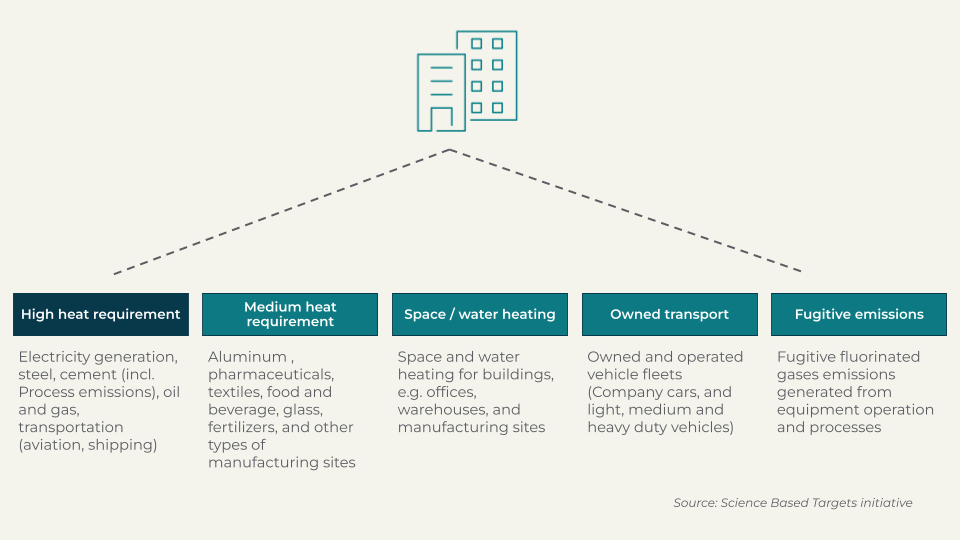
The updated scope 1 framework creates a level playing field for diverse companies to define and deliver science-aligned climate ambition.
2) Low-carbon electricity focus for scope 2
SBTi is now proposing a single required scope 2 target for all companies: a low-carbon electricity alignment target. Defining the target as ‘low-carbon’ rather than ‘renewable’ broadens the range of eligible technologies, including options such as natural gas with carbon capture and storage.
While SBTi would continue to allow the use of certificates to meet this target, the draft signals tighter quality guardrails, in line with evolving best practices and the forthcoming Greenhouse Gas Protocol Scope 2 Standard. These include provisions for physical deliverability, hourly matching, and a commissioning or re-powering date limit. Given these stricter requirements, SBTi may also introduce limited exclusions in markets where credible low‑carbon electricity options are unavailable.
3) Flexibility in scope 3 targets
Acknowledging the challenges companies face in addressing scope 3 emissions, SBTi has presented changes intended to make scope 3 targets more effective and actionable, including category- and activity-specific targets, as well as the limited use of market-based mechanisms.
Category- and activity-specific targets:
A major shift in the draft is that targets would no longer be set holistically for scope 3; instead, companies would be required to set targets for each category that represents 5% or more of total scope 3 emissions, as well as for each priority emission source (as defined by SBTi) within each of these categories. The available target-setting methods would then vary for each category and activity.
While this new approach may require more granular GHG emissions inventories, it also allows companies to concentrate on their most significant and influenceable emissions sources, and spend less time on lower-impact areas. To support this more targeted strategy, the draft would allow companies to exclude certain emissions sources, such as those from micro, small, and medium-sized enterprise suppliers, second-hand goods, and employee commuting.
Market-based mechanisms:
The draft introduces a hierarchical intervention framework with four scope 3 intervention levels that reflect the varying traceability of different emissions sources: activity, counterparty, activity pool, and sector. The new approach would allow the use of environmental attribute certificates (EACs) that meet integrity principles (currently under development) and would require companies to disclose what portion of their target is met at each intervention level.
While elements of this approach are still under review, the direction emphasizes the importance of near-term action. Enabling the use of high‑quality market‑based solutions can help accelerate progress today, sending powerful market signals, driving decarbonization across complex value chains, and supporting the development of longer-term solutions.
| Scope 3 Intervention Levels | |||
| Activity | Counterparty | Activity Pool | Sector |
| Direct changes at the emissions source | Supplier or customer engagement, including cascading science-based targets requirements | Improving performance of the pool within which the activity is embedded | Sector-level interventions (e.g., unbundled procurement of EACs), used only when interventions at the activity or activity pool level are not feasible |
4. Ongoing emissions responsibility
The current draft introduces the Ongoing Emissions Responsibility (OER) framework, which combines the concepts of Beyond Value Chain Mitigation and the treatment of residual emissions. Under this framework, companies would be formally recognized for taking earlier voluntary action to address the impact of their ongoing emissions and, beginning in 2035, large companies would be required to progressively assume responsibility for these emissions through the procurement of carbon removals.
While the focus remains on direct decarbonization, the post-2035 requirement aims to ensure that an increasing proportion of these removals deliver long-lived carbon storage so that by the time companies reach their net-zero targets, corresponding removal capacity has been developed to address residual emissions.
5. Focus on target-setting cycle
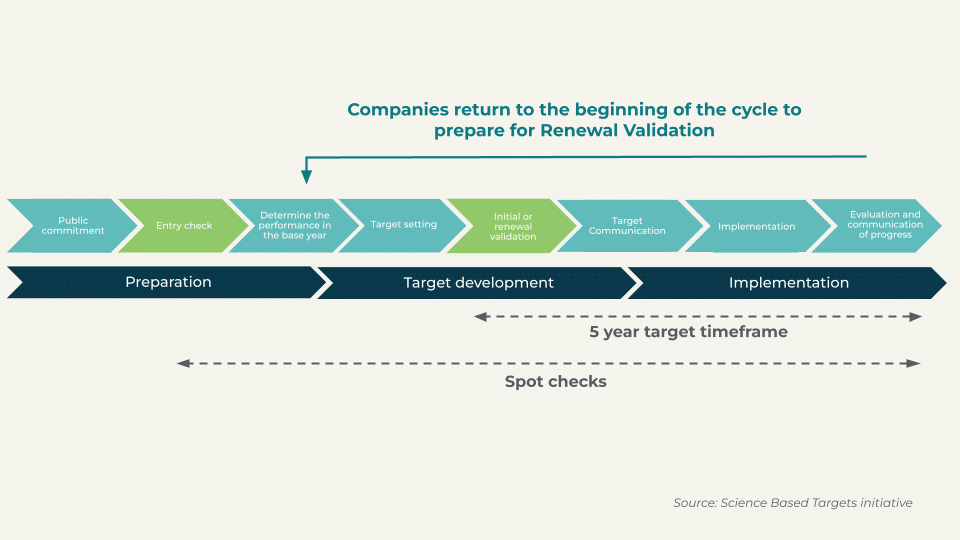
Historically, companies validated their targets with SBTi and then independently managed progress tracking, target updates, and subsequent cycles once initial near-term targets were reached. The current draft proposes a five-year, three-stage process to drive continuous improvement and accountability across target cycles: entry check, initial validation, and renewal validation. Three different types of claims would also be available , depending on where a company is in their cycle: commitment, performance, and conformance.
Proactive steps amid evolving guidance
Comparing SBTi’s first and second drafts, we believe SBTi is committed to several core directions, like independent scope 1 targets and a stronger role for market-based mechanisms under clear guardrails. While we await the final standard, there are steps companies can take to start preparing for this new way of setting targets, including:


Exploring market-based mechanisms for your scope 3 emissions that lack opportunities for direct mitigation

As the SBTi protocol continues to evolve, our team of global climate experts will continue to support businesses with scalable, credible decarbonization solutions across scope 1, 2, and 3 emissions. If you would like to discuss the impacts of these guidance shifts on your organization, please reach out to our team today.
Learn how your business can accelerate meaningful progress.
With over twenty years of experience helping leading businesses take urgent action on climate change, 3Degrees offers the practical expertise sustainability leaders need to navigate the dynamic landscape of reporting frameworks.