Biomethane and Renewable Natural Gas (RNG): Frequently Asked Questions
Get answers to common questions about biomethane and renewable natural gas (RNG), from how it is produced and what feedstocks are used, to how companies are using it to reduce scope 1 emissions and meet net-zero targets.
Procure biomethane certificates today

The biomethane production process in a nutshell.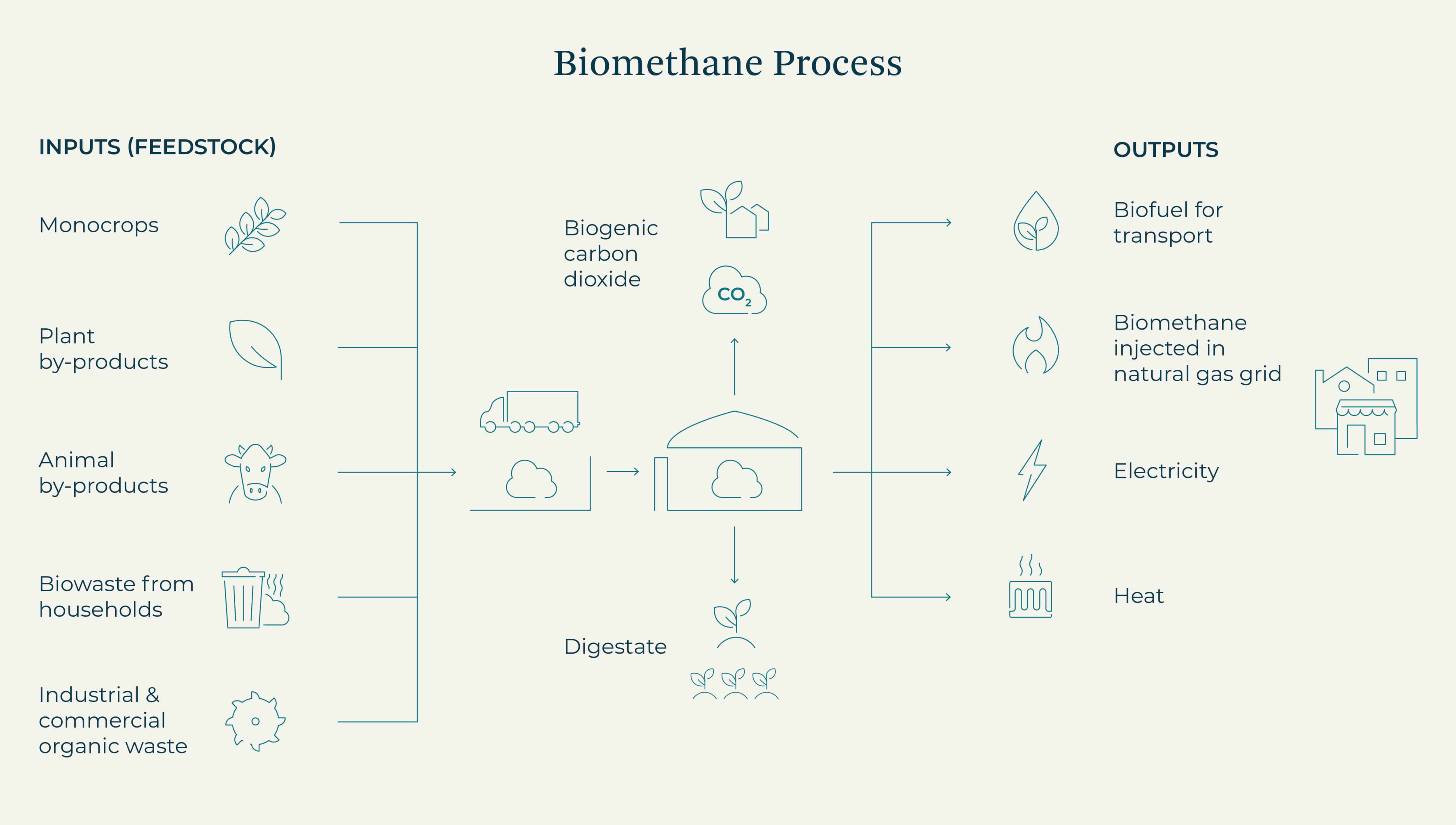
Understanding biomethane and renewable natural gas (RNG)
What is biomethane or renewable natural gas (RNG)?
Biomethane is a renewable gas produced by upgrading biogas so that it closely matches the quality of conventional natural gas and can be used in the same applications. It is often referred to as renewable natural gas (RNG), particularly in North America.
What is the difference between biogas and biomethane?
Biogas is the raw gas produced from the anaerobic digestion of organic materials such as agricultural waste, manure, food waste, and sewage sludge. Biomethane is biogas that has been cleaned and upgraded to remove carbon dioxide, water, and impurities, resulting in a high‑methane gas suitable for grid injection or use as a vehicle fuel. This upgrading step is what distinguishes biogas projects that generate on-site energy from biomethane projects that supply low-carbon gas to the wider market.
How does biomethane compare to conventional natural gas?
Upgraded biomethane has combustion properties and energy content very similar to conventional natural gas, which means it can generally be used in existing boilers, CHP units, industrial burners, and CNG/LNG vehicles without major equipment changes. Its main advantage is its renewable origin and significantly lower lifecycle greenhouse gas emissions.
Is biomethane considered carbon neutral?
Biomethane is generally considered a low‑carbon fuel because the CO₂ released during combustion originates from recently absorbed biogenic carbon rather than fossil sources. In some pathways, such as manure‑based projects that avoid methane emissions, lifecycle emissions can even be net‑negative. Since the feedstock is renewable, the carbon emissions that result from combusting RNG are considered biogenic, like the carbon emissions from other sustainable biofuels.
The role of biomethane in the upcoming EU ETS2
Under ETS2, biomethane that is certified with a Proof of Sustainability (PoS) from an EU Commission-approved voluntary scheme (e.g. ISCC) qualifies as zero-emission, provided it meets RED III sustainability and GHG criteria. This makes certified biomethane a direct compliance tool for reducing future allowance costs under ETS2.
Production, feedstocks, and technology
How is biomethane produced from biogas?
To create biomethane, you typically start with “biogas,” which is a mixture of methane and other gases (mainly CO2) that have been produced from organic feedstocks. It is captured from the decomposition of organic waste in landfills or anaerobic digesters that process waste from food processing plants, agricultural facilities, or wastewater treatment plants. The biogas gets captured, cleaned, and then either injected into the national natural gas pipeline or shipped to the point of use, offering a climate-friendly alternative to fossil fuels.
What are typical feedstocks for biomethane projects?
Common feedstocks include agricultural residues and manure, food and beverage processing waste, municipal organic solid waste, and wastewater treatment sludge. The choice of feedstock influences methane yield, project economics, and eligibility under different policy schemes. Waste-based feedstocks are particularly valuable because they can generate biomethane with a very low, or in some cases negative, carbon intensity score, which matters for compliance under frameworks such as the U.S. Renewable Fuel Standard (RFS) or the EU’s Renewable Energy Directive (RED III).
What is the difference between using biogas on‑site and upgrading to biomethane?
On‑site biogas use typically involves burning raw gas in a CHP unit or boiler for local heat and power, often at the site where the waste is generated. Upgrading to biomethane enables injection into gas grids or use as a transport fuel, opening up a wider market and often improving climate and financial performance.
Check out these resources to help you understand how to leverage biomethane as a practical, zero-emission solution.
As companies work toward net zero, biomethane is becoming a vital decarbonisation tool. In this episode of our biomethane series, we explore key opportunities and risks to help corporate buyers make informed decisions.
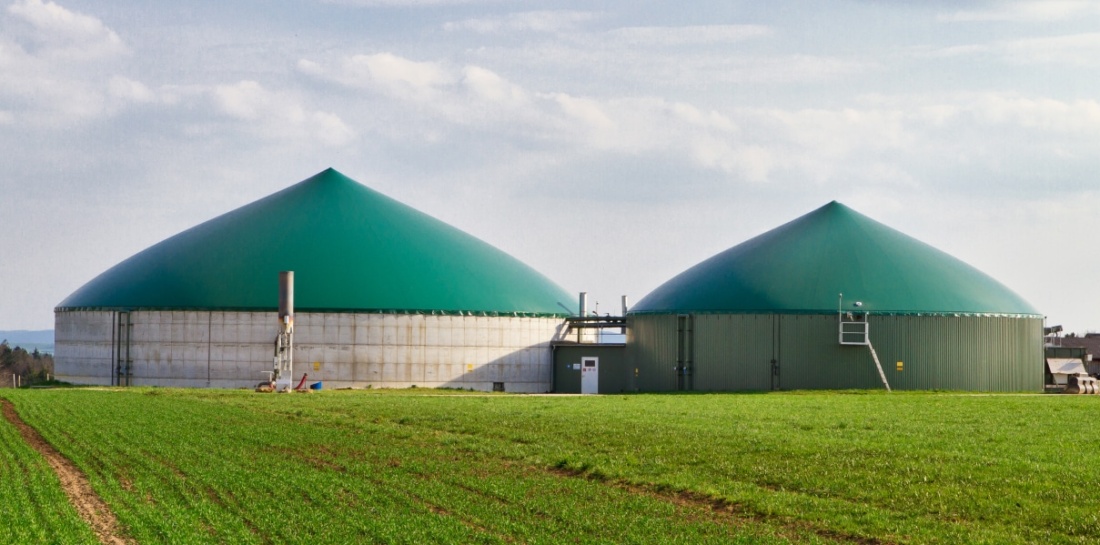
Watch our video to learn about the key benefits of biomethane purchase agreements and how they could integrate into your sustainability efforts.
Watch our short video to better understand EU biomethane market dynamics, and how your organisation can get involved.
Regional terminology and market uses
How is terminology different in North America and Europe?
In North America, “renewable natural gas (RNG)” is the most widely used term for upgraded biogas that meets pipeline quality standards. In Europe, “biomethane” is the dominant term, while “biogas” usually refers to lower‑quality gas used on‑site for heat or power generation.
How is RNG typically used in North America?
In North America, RNG is commonly injected into natural gas pipelines and used to decarbonize building heat, industrial processes, and power generation. It is also widely used as a low-carbon transport fuel for trucks, buses, and fleets under programs such as the federal Renewable Fuel Standard (RFS) and state-level Low Carbon Fuel Standards (LCFS), which generate tradeable credits that improve project economics.
How is biomethane typically used in Europe?
In Europe, biomethane is increasingly injected into gas grids to replace fossil gas in residential, commercial, and industrial applications. It also plays a growing role in decarbonizing heavy‑duty transport and supporting EU climate and energy targets through schemes linked to the Renewable Energy Directive (RED) and national support mechanisms. Companies purchasing biomethane in Europe typically do so via a biomethane purchase agreement (BPA) or by acquiring guarantees of origin (GOs), the European certification instrument used to prove renewable gas consumption.
Which sectors benefit most from biomethane?
Key sectors include heavy industry (such as chemicals, cement, and food and beverage), district heating networks, and combined heat and power installations, like in healthcare and pharmaceutical processes. Transport applications, particularly heavy‑duty trucking, bus fleets, and some maritime uses, also benefit from biomethane as a drop‑in, low‑carbon fuel.
Infrastructure, policy, and market challenges
Can existing gas infrastructure be used for biomethane?
In most cases, upgraded biomethane that meets local gas quality specifications can be transported, stored, and used in existing gas pipeline networks and end‑use equipment. This allows companies to decarbonize without fully replacing their current gas‑based systems. This is particularly relevant for hard-to-abate industrial sectors where full electrification is not yet a viable option.
What are the main policy drivers for biomethane in Europe?
European market growth is supported by EU‑level frameworks like REPowerEU biomethane targets and the Renewable Energy Directive, alongside national support schemes for grid injection and use in transport. These policies aim to scale domestic production, enhance energy security, and reduce emissions in hard‑to‑abate sectors. The REPowerEU plan, for instance, set a target of producing 35 billion cubic metres (bcm) of biomethane per year in Europe by 2030, underscoring the scale of ambition behind these policies.
What are the key challenges for expanding biomethane in Europe?
Important challenges include grid connection constraints, project financing, permitting complexity, and competition for sustainable feedstocks. Harmonizing guarantees of origin and creating clear long‑term off‑take frameworks across EU member states are also critical for sustained growth.
What are the main challenges and opportunities in today’s biomethane markets?
Across regions, developers and buyers face policy uncertainty, the need for infrastructure investment, and stringent requirements for feedstock sustainability and traceability. At the same time, there are strong opportunities in long‑term decarbonization contracts for industrial customers, low‑carbon transport fuel markets, and integration with other renewable energy solutions. Companies that act now to secure long-term biomethane supply agreements are better positioned to manage carbon costs and meet increasingly stringent reporting requirements, from SBTi targets to CSRD disclosures.
Get help assessing your EU ETS2 exposure
Leverage biomethane as a practical, zero-emission compliance solution under ETS2 – starting now.