Source biomethane certificates today
Leverage biomethane as a practical, zero-emission compliance solution under ETS2

At a glance
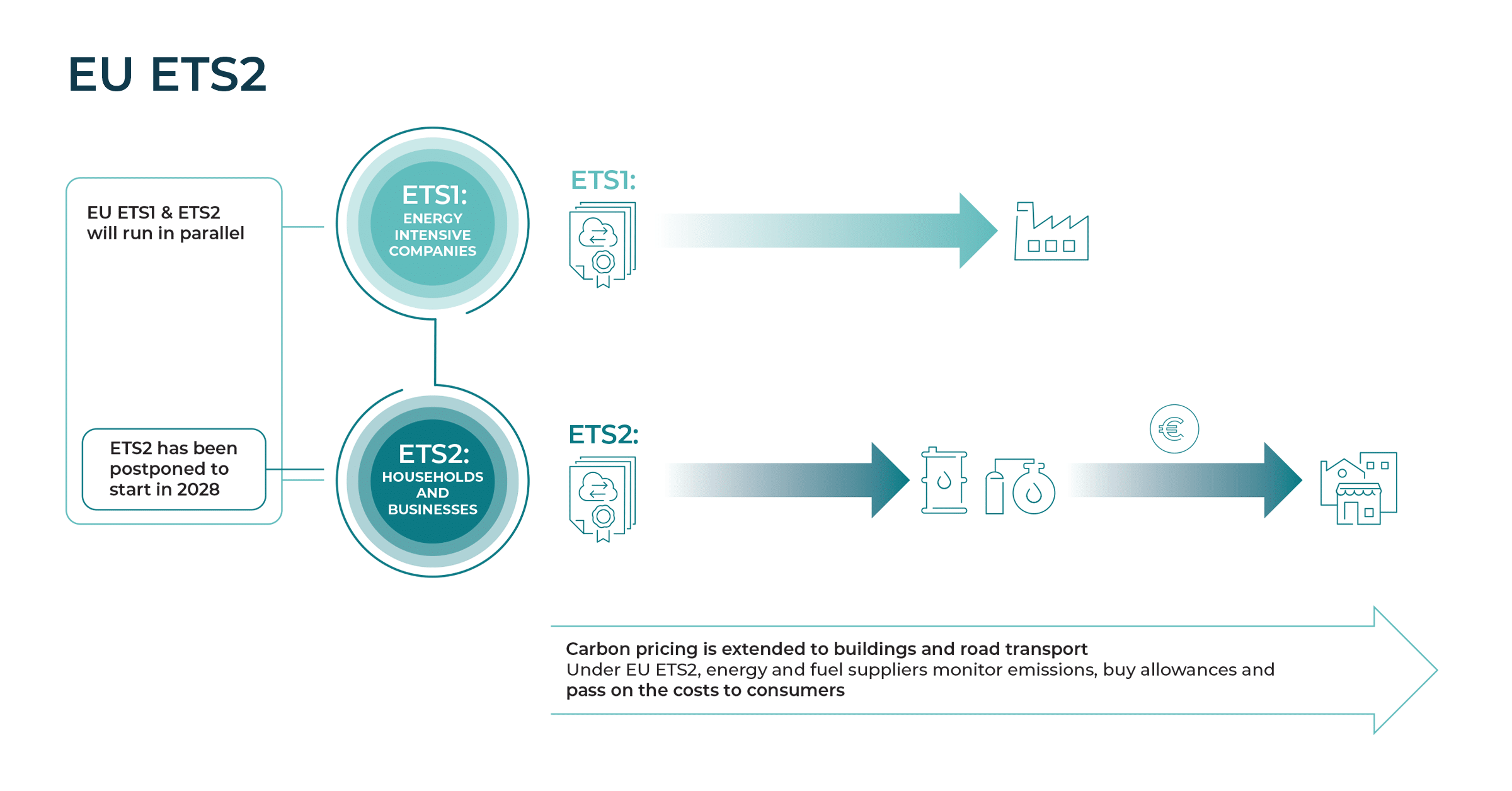
Postponed from 2027 to 2028, the EU’s new carbon pricing system, EU ETS2, will run in parallel to the existing ETS1, expanding carbon pricing coverage to emissions from fuels used in road transport, buildings, and smaller industries. Unlike the current EU ETS (ETS1), there is no free allocation and instead all allowances must be purchased at auction, meaning every tonne of CO₂ will carry a cost.
This one-year delay reflects an agreement by Member States, following a request supported by 19 countries, with the Council’s general position setting ETS2 implementation for 2028 instead of 2027.
The system’s declining cap, annual surrender requirements, and penalties for shortfalls will steadily increase compliance costs for fuel suppliers. These costs are highly likely to be passed down the supply chain to customers who rely on natural gas, heating fuels, or vehicle fleets. As allowance prices rise, customers could expect increases in their energy and transport costs.
A key difference under ETS2 is that, for the first time, smaller industrials and corporates with natural gas consumption below 20MW thermal capacity will also be indirectly exposed to carbon costs through their energy suppliers. Previously, only large industrial sites regulated under the existing ETS1 faced such costs. This expands the incentive to purchase certified biomethane as a zero-carbon alternative, not just for large emitters but for a much broader range of energy users across Europe.
Within this framework, biomethane certified under RED III is treated as zero-emission, allowing regulated fuel suppliers to reduce allowance obligations and downstream customers manage exposure to rising carbon prices.
What is EU ETS2?
EU ETS2 was created under the EU’s Fit for 55 package to extend carbon pricing into sectors previously not covered by Emissions Trading System 1 (ETS1).
Each allowance equals 1 tonne of CO2 equivalent (CO2e).
What is expected under ETS2?
- Fuel suppliers must surrender allowances annually to match emissions from the fuels they sell instead of households, offices or car users monitoring and reporting emissions;
- A steadily declining cap will deliver a 42% emissions reduction by 2030 (vs 2005);
- As the cap reduces, fewer allowances will be available which could likely increase compliance costs;
- ETS2 is EU-wide, but the timing of implementation and the extent of cost pass-through may vary across Member States.
How does ETS work?
Compliance mechanisms
- Obligations: Fuel suppliers must purchase and surrender allowances at auction equal to the total emissions in each calendar year;
- Penalties: ~€100 per tonne of CO₂e not covered by surrendered allowances (inflation-adjusted), with the additional requirement to surrender the shortfall in the following compliance year;
- Price stabiliser: If carbon prices exceed €45/t CO₂ for six months, additional allowances may be released;
- Timing flexibility: Monitoring obligations began in 2024, with permits due in 2025. Although the system was originally scheduled for first compliance in 2027, Member States have now agreed to postpone ETS2 by one year, a move advocated by 19 Member States, meaning implementation would start in 2028 under the Council’s general position. If fossil fuel prices spike in 2026, the Commission would still retain the option to delay the launch further.
Biomethane as a strategic solution
Under ETS2, biomethane that is certified with a Proof of Sustainability (PoS) from an EU Commission-approved voluntary scheme (e.g. ISCC) qualifies as zero-emission, provided it meets RED III sustainability and GHG criteria. This makes certified biomethane a direct compliance tool for reducing future allowance costs under ETS2.

Every unit of biomethane replaces fossil gas, cutting the number of allowances a supplier must purchase which subsequently protects downstream customers from cost pass-through.
ETS2 allowance prices are expected to potentially exceed those observed in the existing ETS1 (current ETS1 allowance price of approximately €90), highlighting the need to act early. By securing certified biomethane early, corporate customers can effectively lock in a zero-emission energy attribute that reduces Scope 1 emissions while hedging against future ETS2-related carbon cost increases associated with continued fossil natural gas consumption.
Early adoption secures cost advantage and strengthens sustainability credentials.
Strategic impact
ETS2 will fundamentally reshape the cost of heating and transport fuels, for end consumers as well as regulated fuel suppliers. By acting early, entities can:
- Reduce compliance costs before future increases;
- Hedge against future carbon price risk;
- Position themselves as early movers in low-carbon energy transition.
At the same time, existing ETS1 participants should consider that ETS2 could tighten overall decarbonisation economics, driving up fossil fuel costs, increasing competition for low carbon alternatives, and potentially prompting greater policy alignment between the two systems over time.
Get help assessing your ETS2 exposure
Leverage biomethane as a practical, zero-emission compliance solution under ETS2 – starting now.
Related insights

Get answers to common questions about biomethane and renewable natural gas (RNG), from how it is produced and what feedstocks are used, to how companies are using it to reduce scope 1 emissions and meet net-zero targets.
As companies work toward net zero, biomethane is becoming a vital decarbonisation tool. In this episode of our biomethane series, we explore key opportunities and risks to help corporate buyers make informed decisions.

Watch our short video to better understand EU biomethane market dynamics, and how your organisation can get involved.