
The secret to scaling your clean energy portfolio might reside in your tax department.
At many companies, tax optimization and sustainability strategies live in two different worlds. Tax teams treat mechanisms like transferable tax credits (TTCs) as straightforward financial transactions, and sustainability departments feel it’s an area that’s “not in my lane”, where they have little input. That disconnect leaves significant, strategic value untapped, where sustainability teams miss out on the opportunity to leverage tax savings to drive other initiatives forward.
In 2025, a quarter of Fortune 1000 companies participated in the TTC market, capturing hundreds of millions of dollars in tax savings. Yet, only a fraction of these buyers connected the dots between their TTC purchase and its environmental impact by publicly mentioning them in their sustainability reports. Instead, most list them only as generic tax assets in their financial reporting. However, purchasing TTCs provides material support to decarbonization projects and can also enable the procurement of high impact energy attribute certificates (EACs).
Too often, sustainability is viewed as a pure cost center. Compounding this challenge, the most cost-effective renewable energy procurement strategies often require companies to manage notable market risk. By embedding TTCs into your sustainability strategy, your team can help finance decarbonization projects, advance sustainability goals, lower operating costs, reduce market risk, and position the sustainability function as a strategic contributor rather than a net expense.
Not only are TTCs within sustainability’s domain, they are essential to a robust renewable energy strategy in today’s market.
Introduced under the 2022 Inflation Reduction Act (IRA), Section 6418 transferability allows project developers to sell tax credits directly to corporate buyers. This is a game changer for project developers and corporate buyers, alike.
Most project developers lack the tax liability required to use the tax credits themselves, and previously had to go through the more complex process of sourcing tax equity investors. Transferability allows developers to monetize the credits to finance development of these decarbonization projects.
For corporate TTC buyers, the economic case is simple: credits are purchased at a discount, meaning the purchasing company can see immediate tax savings. For example, a buyer might acquire a $100M tax credit for $92M, offsetting $100M in tax liability while realizing a direct $8M gain.
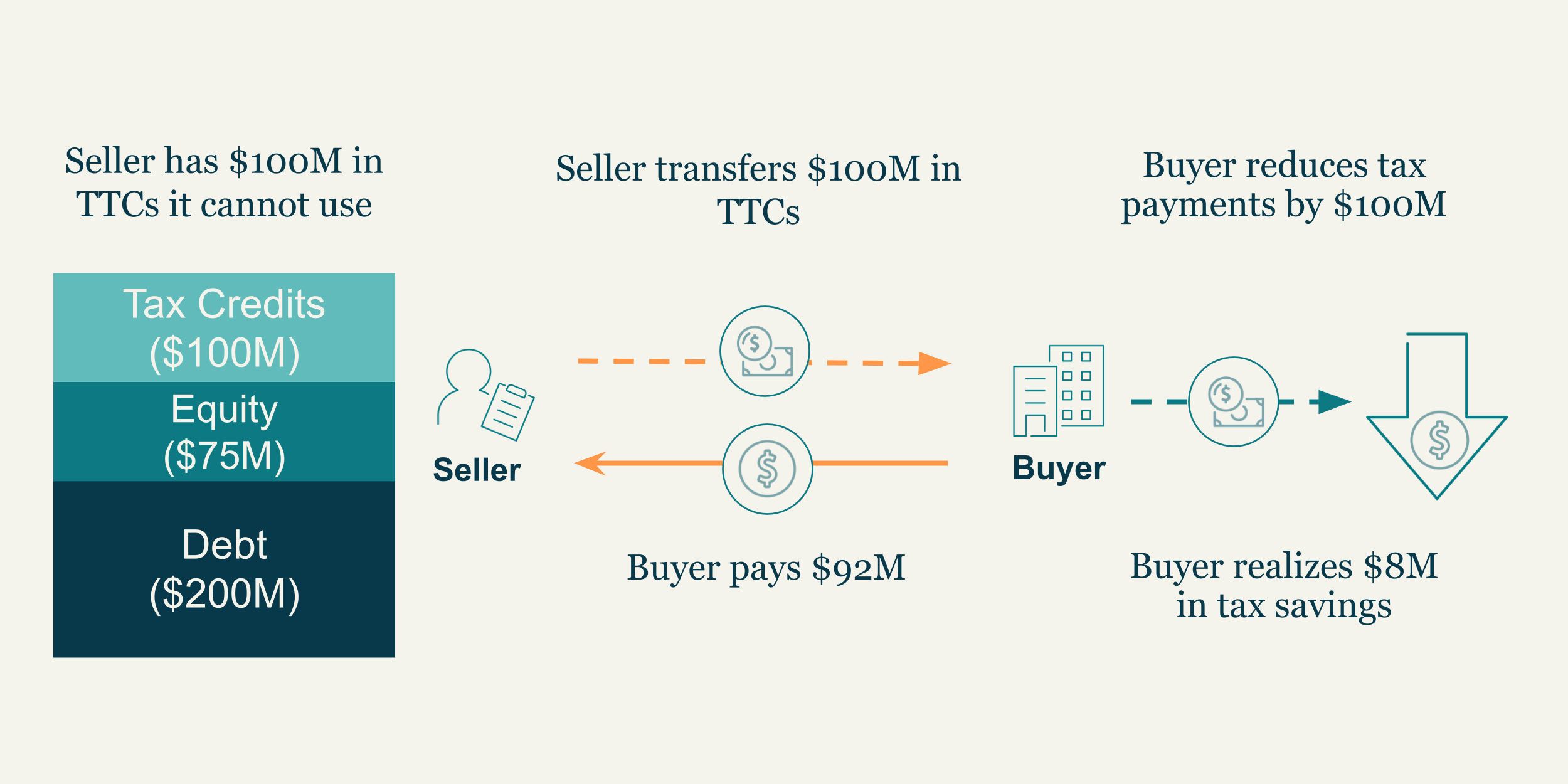
Tax credit purchases drive environmental impact
TTCs are within sustainability’s purview for three reasons:
Purchasing TTCs provides real support to decarbonization projects.
By purchasing TTCs, companies help developers finance decarbonization projects. While tax credits alone don’t allow claims of renewable energy use or emission reductions, companies can (and should) communicate how their TTC purchase helps support these projects.
Sustainability involvement is crucial in selecting the most impactful TTCs.
When tax teams purchase credits in isolation, they typically prioritize credits with the lowest risk and lowest price, without considering the project’s specific characteristics or alignment with the company’s mission. With so much variation in the technology and impact potential, sustainability’s involvement ensures capital flows to high-value projects – both from a financial and impact perspective. For example, if cost and risk are equal between two clean electricity projects, the sustainability team can push to purchase credits from the project in a higher emission market, or one that reinforces an existing sustainability story at the organization (e.g., EV charging credits for companies with large EV fleets).
Some TTCs can come with EACs that allow for direct sustainability claims to be made.
While all TTC purchases allow companies to indirectly claim support of decarbonization projects, some can be paired with renewable energy certificates (RECs) or carbon credits from the same project, enabling direct renewable energy or carbon reduction claims. While projects with both TTCs and EACs available are less common, when sourced they present an extremely high-impact and low-cost mechanism for making verifiable environmental claims.
Financial benefit of TTCs
Tax savings from TTCs purchases are relatively straightforward. With current credit pricing ranging between 88 and 92 cents on the dollar, purchasing companies benefit from ~8-12% in tax savings. Although the standalone savings are attractive, it’s missing the broader financial strategy, which includes the monetary benefits of TTC purchases paired with project RECs.

When RECs are acquired via a TTC purchase, the sustainability team does not need to purchase RECs via an alternative method requiring a cash outlay. This can result in direct savings if the RECs are included in the TTC price or in lower per REC pricing if the RECs are subsidized as part of the deal.

An even larger benefit, though harder to quantify, is diversification of risk. The inclusion of RECs in a TTC deal can help diversify a company’s renewable energy portfolio and reduce its exposure to risk from long-term contracts. For example, while virtual power purchase agreements (VPPAs) are a cornerstone of many renewable energy strategies, they come with significant wholesale power market risk. Sourcing RECs via a TTC transaction could replace RECs from a VPPA, reducing associated risks while still supporting the buildout of a new renewable electricity project. For companies with existing PPAs, a portion of TTC savings can be allocated to “PPA volatility funds” that can be used to smooth cash flow in the event of unexpected PPA settlements.
TTC optimization requires cross-functional collaboration
The most successful sustainability strategy does not function in a vacuum but is aligned with the company’s core financial and operational strategy. Historically, sustainability teams have been forced to pursue climate targets through mechanisms that are not integrated with the broader business strategy while simultaneously requesting additional budget to support those efforts.
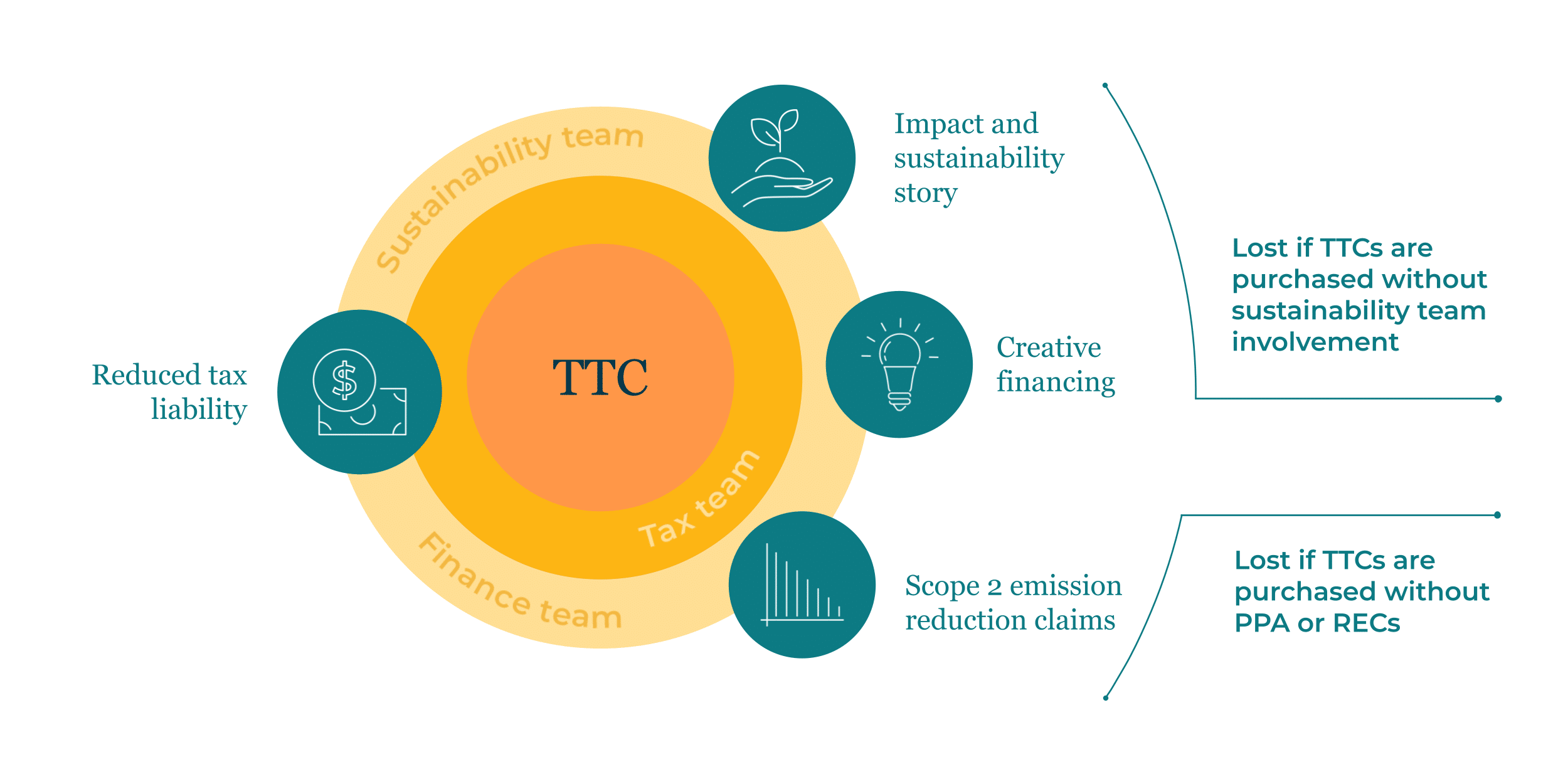
Integrating TTC procurement into your sustainability framework enables your team to:
- Bring a cost saving measure to the table: TTCs are one of very few ways to procure RECs while realizing savings rather than incurring a net expense. Identifying these opportunities helps shift the conversation about implementing sustainability initiatives.
- Lower cashflow volatility: Finance teams (e.g., tax, treasury, etc.) will appreciate that TTCs can reduce reliance on VPPAs for REC volumes, help manage PPA risk profiles, and reduce cashflow volatility.
- Embed corporate mission in capital allocation: Support of high impact projects that integrate company goals and values.
Maximizing Strategic Value with TTC Advisory Services
Uniting the worlds of tax and sustainability is essential to a renewable energy strategy that drives measurable impact, effectively uses capital, and focuses on integration into the company’s operations and mission.
By looking holistically at financial benefits combined with the broader sustainability story, tax credit procurement allows for a sustainability strategy that contributes to the bottom line. Sustainability-driven TTC purchases are a strategic device that forward-thinking corporations can employ to support clean energy deployment at scale while capturing maximum financial, environmental, and reputational value. Getting there, though, requires the right structure and the right partner.
3Degrees helps put this into practice. Backed by long-standing relationships with project developers and tax credit platforms, we work with companies to identify where tax capacity can have greatest strategic relevance and bring finance and sustainability teams together early to structure deals that build climate-capital.
Build your TTC strategy
3Degrees helps companies choose a TTC opportunity based on more than price alone, backed by the climate story to substantiate it. Improve your financial case for climate action and show your team’s bottom-line value today.