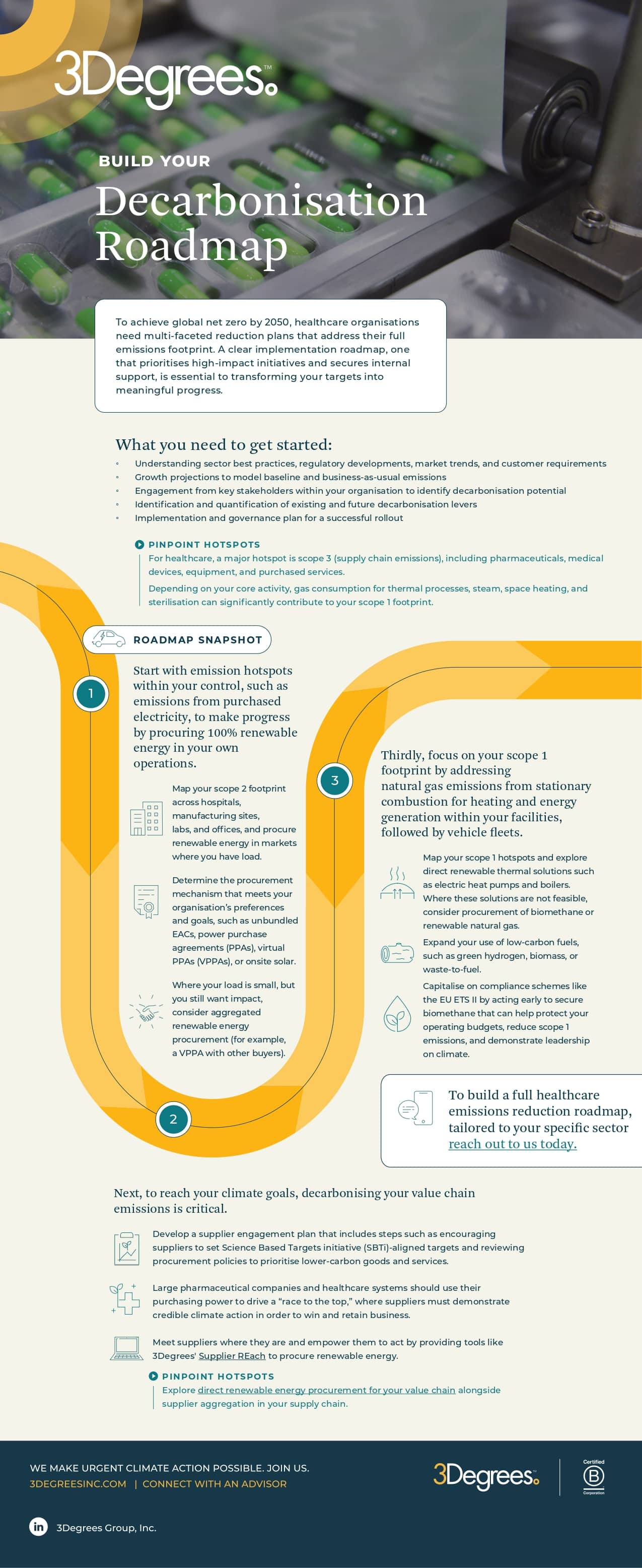
A Guide to Healthcare Decarbonisation Roadmap
Ready to build your roadmap?
Get in touch with us
Healthcare organisations are under growing pressure to cut emissions. From rising energy costs to tightening disclosure rules, it can be daunting to know where to start and make progress in a way that works for pharmaceuticals, medical devices, and manufacturing sites.
To help, we’ve outlined a decarbonisation roadmap tailored to healthcare regardless of where you are in the journey. See examples of how peers in various industries are taking action, and more.
What you need to get started

Understand sector best practices, regulatory developments, market trends, and customer requirements

Engagement from key stakeholders within your organisation to identify decarbonisation potential

Growth projections to model baseline and business-as-usual emissions growth

Identification and quantification of existing and future decarbonisation levers
PINPOINT HOTSPOTS
- For healthcare, a major hotspot is scope 3 (supply chain emissions), including pharmaceuticals, medical devices, equipment, and purchased services.
- Depending on your core activity, gas consumption for thermal processes, steam, space heating, and sterilisation can significantly contribute to your scope 1 footprint.

Implementation and governance plan for a successful rollout
Laying a foundation
See how different industries with similar challenges to healthcare laid the groundwork for their decarbonisation.
of

- Expanded and refined its greenhouse gas (GHG) inventory, uncovering emissions hotspots.
- Identified the “hotspots” within direct operations and investments.
- Documented, repeatable process for future inventories.

- Established a climate task force: They aligned global, cross-functional leadership to ensure their roadmap was operationally sound.
- Identified emission hotspots: They moved from spend-based estimates to granular, activity-based data for their highest-impact categories.
- Committed to SBTi: They formalised a near-term target that covers all three scopes, including a robust supplier engagement goal.

- Achieved 100% renewable energy goal for shared e-vehicles.
- Procured a global energy attribute certificate (EAC) portfolio of distributed load for three years across 33 countries.
- Advanced 5 years ahead of its scope 1 and 2 science-based target through renewables procurement.
Roadmap snapshot
STEP 1:
Start with emission hotspots within your control, such as emissions from purchased electricity, to make progress by procuring 100% renewable energy in your own operations.

Map your scope 2 footprint across hospitals, manufacturing sites, labs, and offices, and procure renewable energy in markets where you have load.

Determine the procurement mechanism that meets your organisation’s preferences and goals, such as unbundled EACs, power purchase agreements (PPAs), virtual PPAs (VPPAs), or onsite solar.

Where your load is small, but you still want impact, consider aggregated renewable energy procurement (for example, a VPPA with other buyers).
Learn from other organisations and discover how they addressed their emissions from purchased electricity.

See how HubSpot engaged 3Degrees to explore impactful options for global renewable energy.
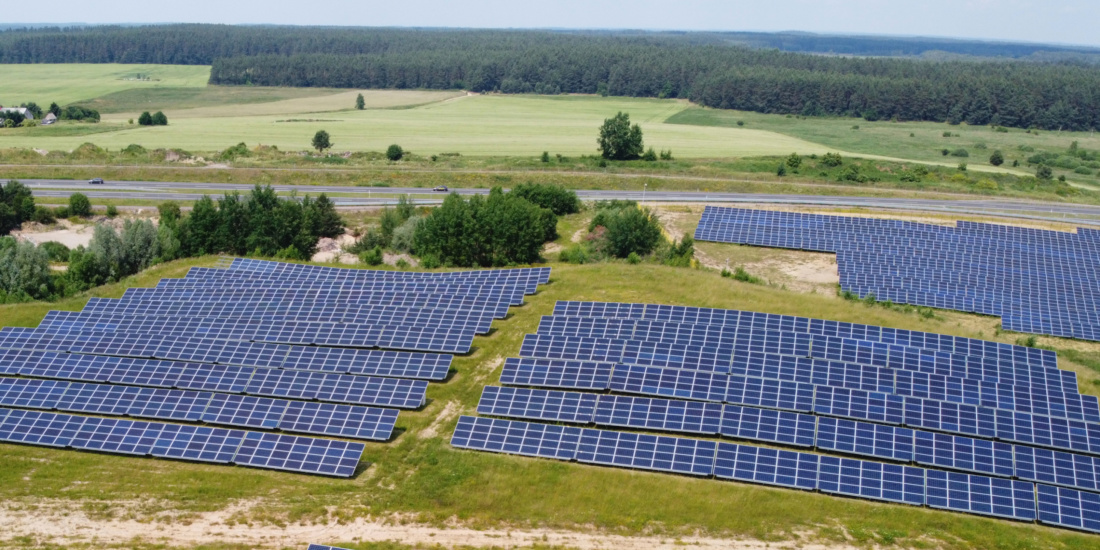

Learn how 3Degrees helped a data center company tackle its APAC strategy on its path to procure 100% renewable electricity globally by 2030.
STEP 2:
Scope 3 typically accounts for 70-90% of your total carbon footprint, so a strong focus on your value chain is critical to achieving your climate goals.
Develop a supplier engagement plan that includes steps such as encouraging suppliers to set Science Based Targets initiative (SBTi)‑aligned targets and reviewing procurement policies to prioritise lower‑carbon goods and services.

Large pharmaceutical companies and healthcare systems should use their purchasing power to drive a “race to the top,” where suppliers must demonstrate credible climate action in order to win and retain business.

Meet suppliers where they are and empower them to act by providing tools like 3Degrees’ Supplier REach to procure renewable energy.
PINPOINT HOTSPOTS
- Explore direct renewable energy procurement for your value chain alongside supplier aggregation in your supply chain.
Check out this resources to help you build a supplier action plan.
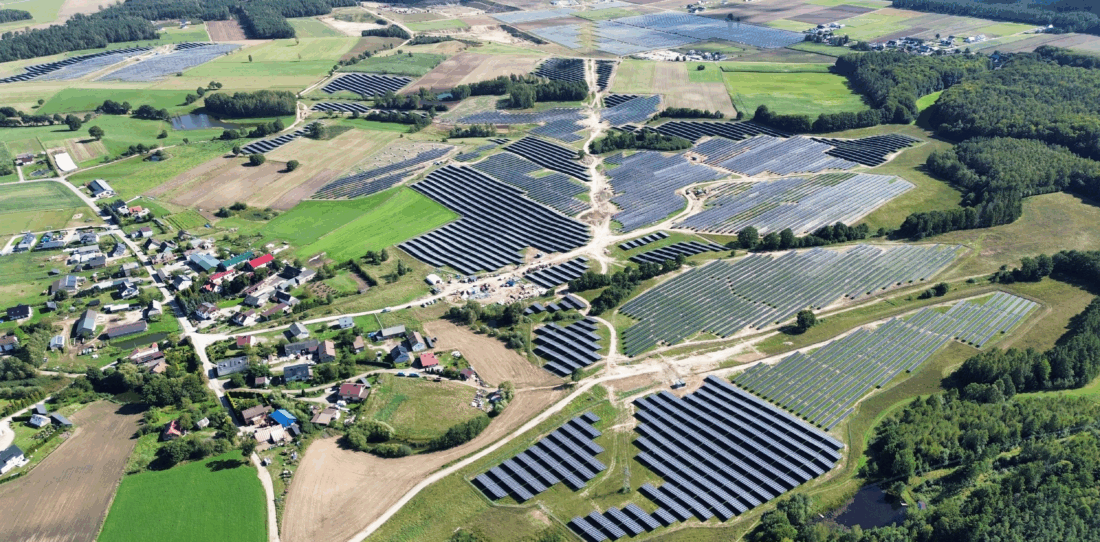
Start partnering with your supply chain to build a successful decarbonization program.

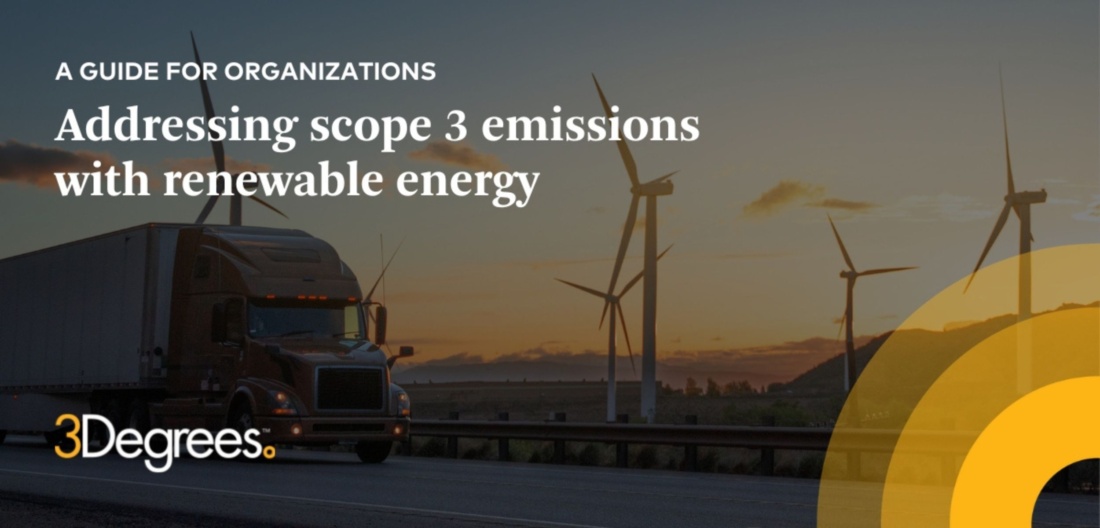
A Practical Guide to Scope 3 Decarbonization through Direct Procurement of Clean Energy Attributes
STEP 3:
Focus on your scope 1 footprint by addressing natural gas emissions from stationary combustion for heating and energy generation within your facilities, followed by vehicle fleets.

Map your scope 1 hotspots and explore direct renewable thermal solutions such as electric heat pumps and boilers. Where these solutions are not feasible, consider procurement of biomethane or renewable natural gas.

Expand your use of low-carbon fuels, such as green hydrogen, biomass, or waste-to-fuel.

Capitalise on compliance schemes like the EU ETS II by acting early to secure biomethane that can help protect your operating budgets, reduce scope 1 emissions, and demonstrate leadership on climate.
Ready to get started on your emissions reductions roadmap?
Our team of healthcare emissions experts are ready to provide your business with scalable solutions to advance your climate targets, and become a leader in the industry.
View the guide as a PDF: